

Fill & Bleed Applications
Category:
A fill and bleed circuit is a combination of pneumatic valve components used to inflate a volume or apparatus in one controllable function and release or vent pressure in a second controllable function. These circuits are commonly used in many applications where a particular pressure, firmness, or position can be controlled with the addition or venting of pressure. Read on to learn more about three typical examples of fill and bleed applications.

Pressure Control Applications
Pressure control systems typically use a fill and bleed type circuit to add or subtract air in maintaining a pressure. They can also be referred to as E/P or Electronic Pressure Control when feedback is provided to read the downstream or output pressure and looped back to tell a PLC or system to fill or bleed more pressure. These can be tremendously accurate depending on the speed and orifice of the valves used in the circuit and the accuray of a pressure transducer.
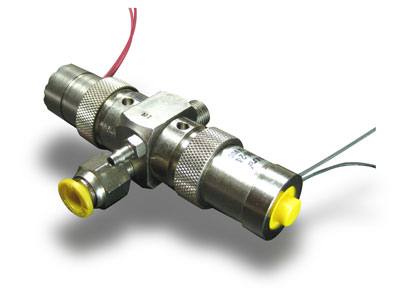
Clippard EV valves are commonly used in these applications for analytical and instrumentation equipment, medical devices such as blood pressure cuffs, and pressure control industrial applications.
Lumbar Support Applications
In lumbar support applications, pressure would be better defined as firmness, where a pneumatic fill and bleed circuit is controlling the air pressure in a flexible bladder built into a seat. Massage or therapy chairs use multiple bladders filling and bleeding pressure that changes the firmness in a sequential pattern massaging the user. These applications can be found in first-class airline seats, train seats, and trucks or mobile cabs where the operator is sitting for extended periods of time.
Positioning Applications
Positioning applications are based on the same principle when applying a fill and bleed circuit along with the basic cylinder formula of Pressure x Area = Force and linear spring force. Using a single-acting cylinder, the linear spring force on the cylinder needs to be overcome with a particular pressure in order to move. As the cylinder moves, the force required to push against the spring force changes, therefore varying the pressure can simply vary the position. For example, if a cylinder was used to move the position of a table up or down, a fill and bleed circuit can be applied to the bottom of the cylinder to adjust pressure, which in turn changes the position.
Fill and bleed circuit components can be quite simple and robust, such as Clippard's FBV manual fill and bleed valves, or electronic valves can be combined for integration with electronic controls to achieve very simple or more complex circuits. Clippard has extensive experience with hundreds of different fill and bleed circuits and a wide variety of applications and industries. Contact us today to discuss your application needs.
|
Related Products |
||||
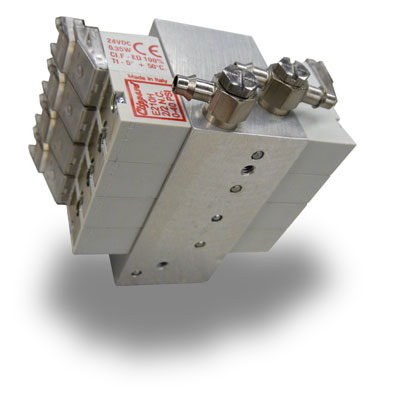
EFB Series Fill & Bleed Circuits |
FBV Series Fill & Bleed Valves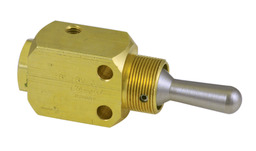 |
|||
Related Content